
 j
j
Every workplace’s text client communication vibe is different. I’ve been places where there are a ton of old motherfuckers around, so there’s basically no text internal communication client at all, and even if there is one, nobody uses it, and those who do are pariahs and are looked at like moon people for even daring to consider internal text client communication as official business correspondence.
Conversely, I’ve also been to places that ran Slack, which means there are like 76 different channels of groups, communities, and teams, and every single message is responded to in 164 different gifs and emojis, and Slack communication is interpreted as official business, and there are major businesses decisions that are locked in via the client.
Where I’m at these days is kind of midway point between the two, where we run Microsoft Teams as our official client. There are plenty of technologically inept olds still in the company that by virtue of either refusing, or are just too old to figure out how to use the client, simply don’t. But I’m fortunate to my department having a lot more technologically savvy users who have no issues using the client, and it’s what we use on the regular to communicate, in and out of the office.
The majority of the etiquette here are users using the default emojis to acknowledge or recognize appreciation, mostly the standard yellow thumbs up, and heart, and if something is funny, then the laughing face emoji.
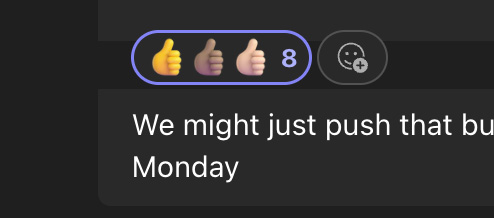
However recently, I’ve noticed a little shift in some user behavior that kind of has me thinking some things. At first, it started with some remarks in some group threads, where the responses aren’t just getting thumbs up’ped, but they’re being thumbs up’ped with both the regular default yellow thumbs up, as well as the black skin tone thumbs up.
Obviously, in spite of my general appreciation of dark humor, I have no issue with black people representing and busting out black skin tone thumbs up emojis. It’s just that I couldn’t help but notice that after these started getting used, it didn’t take long before I noticed that later on, when there was another comment that warranted mass acknowledgement, I would see that in addition to the black skin thumbs ups, there were now users responding with white people thumbs ups.
The thing for me is that I have no qualms with the white folks doing this, it’s just that in my observations, this was behavior that was not done until the emergence of black skin thumbs up emojis. Maybe it’s just me, and maybe I’m likely overthinking things, but there’s something that seems subtly passive aggressive with a hint of racism about the act, as if some of my white colleagues were kind of triggered or offended that some of our black colleagues decided to start utilizing black thumbs up emojis, so they decided to respond with white ones.
And then we have comments that look like the above, where there’s a mish-mash of colored emojis in response to an inconsequential remark in the grand spectrum of a work day.
What if I felt the need to jump in on this racial representation? You know who doesn’t get considered in the great expansion of emoji skin tones? That’s right, Asian folks. There are skin tones to account for white people, black people, and numerous shades of brown to cover Hispanics, Middle Eastern, Indian, or anyone whose skin tone is remotely in the spectrum.
But Asian people? No dice there. No light skin tones with a hint of warmth to encapsulate Asians, and maybe some people from like Southeast Asia, the Pacific Island, or regions of Korea and Japan where there are lot more rural folks with tanned skin could get away with using some of the brown-tone emojis, but the fact of the matter is that there is no real set of emojis that takes into consideration Asian skin tones.
Obviously, the generic yellow thumbs up is not sufficient for Asian folks, because we are not fucking Simpsons characters, and have tones that look that yellow.
Needless to say, I’m leaning in a direction where I wish all skin tones would just be eliminated, and we’re left with just the standardized Simpsons yellow emoji. Take race out of the equation, and eliminate any possibility for such subtle passive aggression. I know all the people utilizing these non-standard emojis and I don’t think they’re trying to be racist, but to me, it kind of comes off that way, especially since racist-ass Microsoft’s emoji catalog doesn’t account for Asians, and if I wanted to jump aboard the representation train, I can’t.
